


Healthcare Website Redesign
Medicaid
members-first redesign
As PacificSource's first Digital Project Manager, I led the year-long rebuild of a legacy Medicaid website for 350,000 members — shaping the UX, information architecture, and content strategy while managing the scope, workflow, and governance. The result was a user-driven experience in Drupal that could scale across lines of business.
Digital Program Leadership
UX & Content Strategy
Governance & Delivery

Client
PacificSource Health Plans
Role
Digital Project Manager UX & Content Strategist
Scale
350,000 Members Year-long Initiative
Core Team
3 Designers • 2 Developers • 2 Writers • Data analyst
Homepage Sessions
Total Sessions
Document Discoverability
Compliance
The Challenge
A migration wasn't going to fix this
PacificSource planned to move its Medicaid website from legacy .NET to Drupal and transfer ownership from IT to Marketing. But the site's structural and technical issues required attention:
Member navigation was essentially three links.
Missing and expired content created compliance risk.
Content reflected internal operations and terminology.
Key resources were buried.
Reliable analytics data were scarce.
The Drupal setup couldn’t support additional lines of business.
The organization behind the experience was equally complex: Creative, Marketing, Engineering, Compliance, Legal, Customer Service, executives, and more than 40 content owners and subject-matter experts all had a stake.
I owned the project and UX strategy end to end—turning research into a new information architecture and content direction, then translating that strategy into requirements, prioritized scope, and a delivery plan for a nine-person core team.
In 2023, the redesign replaced a generic, fragmented homepage with clear paths for members to get started, find care, understand benefits, access their account, and get help.


Discovery & Research
Understand the system before redesigning it
In order to set the direction, I needed to understand page-level usability issues and the systemic problems behind them. I dove into hands-on research while guiding the data analyst and lead writer, combining site and member evidence with internal requirements and comparative research to understand where the experience failed. And what the new system had to support.
CONTENT & IA AUDIT
Map the current experience
Inventoried the legacy site, mapped its structure, and identified outdated content, duplication, gaps, and maintenance risks.
Behavioral Data
See what users actually do
Analyzed site analytics, Hotjar behavior, and search patterns to see how members entered the site, where they struggled, and what they tried to find.
Customer Signals
Identify recurring needs
Synthesized survey feedback and recurring Customer Service questions to identify frequent requests and friction.
PEOPLE & REQUIREMENTS
Balance usability with constraints
Interviewed internal users and SMEs, reviewed comparable health plans, and translated business, accessibility, and regulatory needs into the design and build strategy.

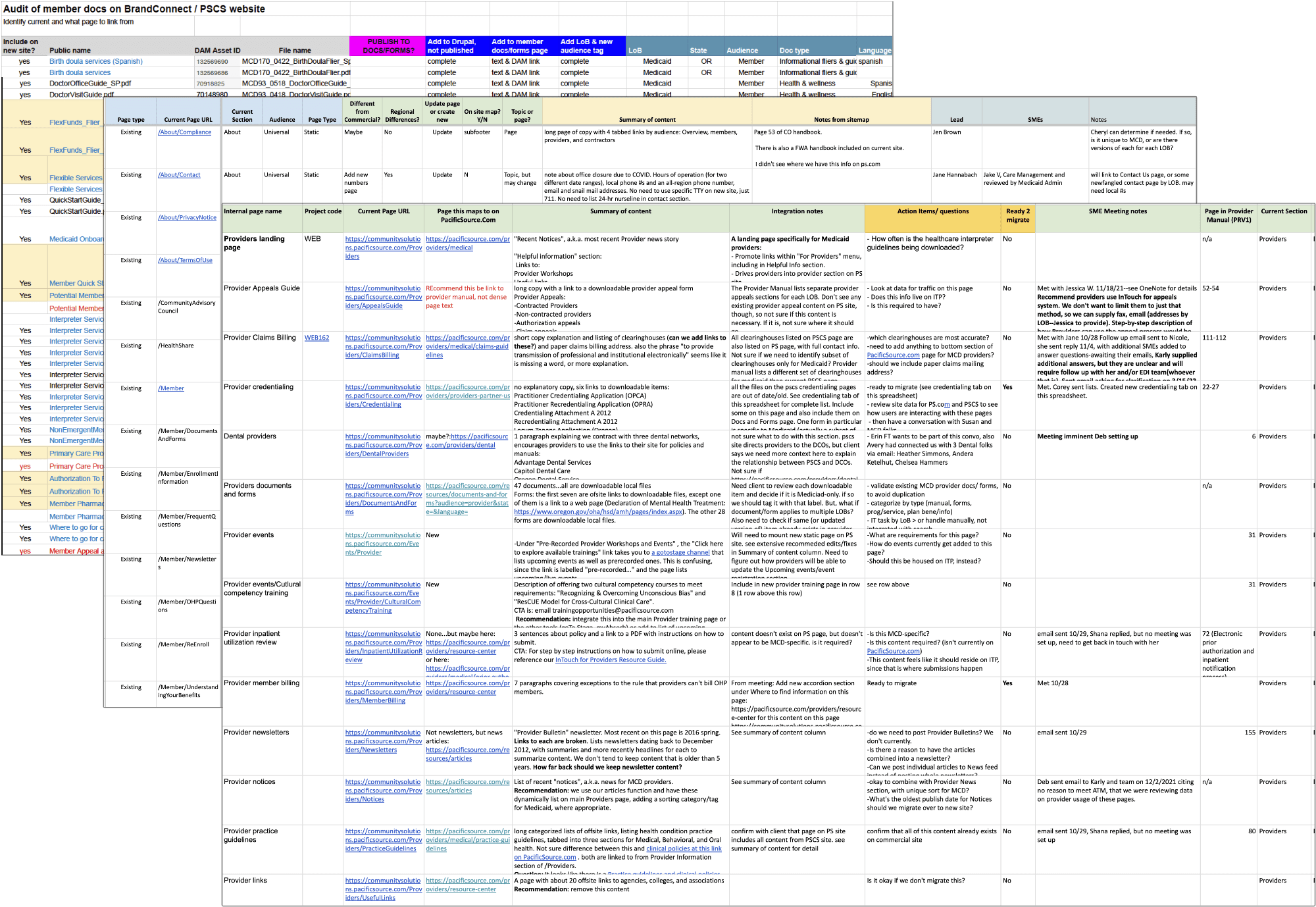

The evidence pointed to a larger problem: the experience reflected how PacificSource operated, not how members looked for care and information.
Information Architecture
Design a structure that can scale
The research showed that the site needed to reflect how people entered, what they needed to do, and which audience they belonged to. Drupal also needed to support more than one product line. I designed a navigation and tagging framework for Medicaid that could accommodate future lines of business while preserving the existing PacificSource site.
AUDIENCE SEGMENTATION
Two core audiences, two content strategies
Members and providers needed different routes to information. Medicaid members engaged directly with Medicaid content, rarely using PacificSource's main site. Meanwhile, providers, who served patients across lines of business, had to check three separate line-of-business sites for similar information. I set the strategy for Medicaid to focus on members, and to consolidate provider content on the main PacificSource site.

Medicaid line-of-business subsite (highlighted) and the provider content that lives on the main PacificSource site.
Navigation Hierarchy
Create a framework that can expand
I worked with engineering to define how Drupal would support multiple lines of business, then designed a tagging system and flexible navigation model. It was built for Medicaid, extensible for future LoB, and could retrofit the existing PacificSource site.
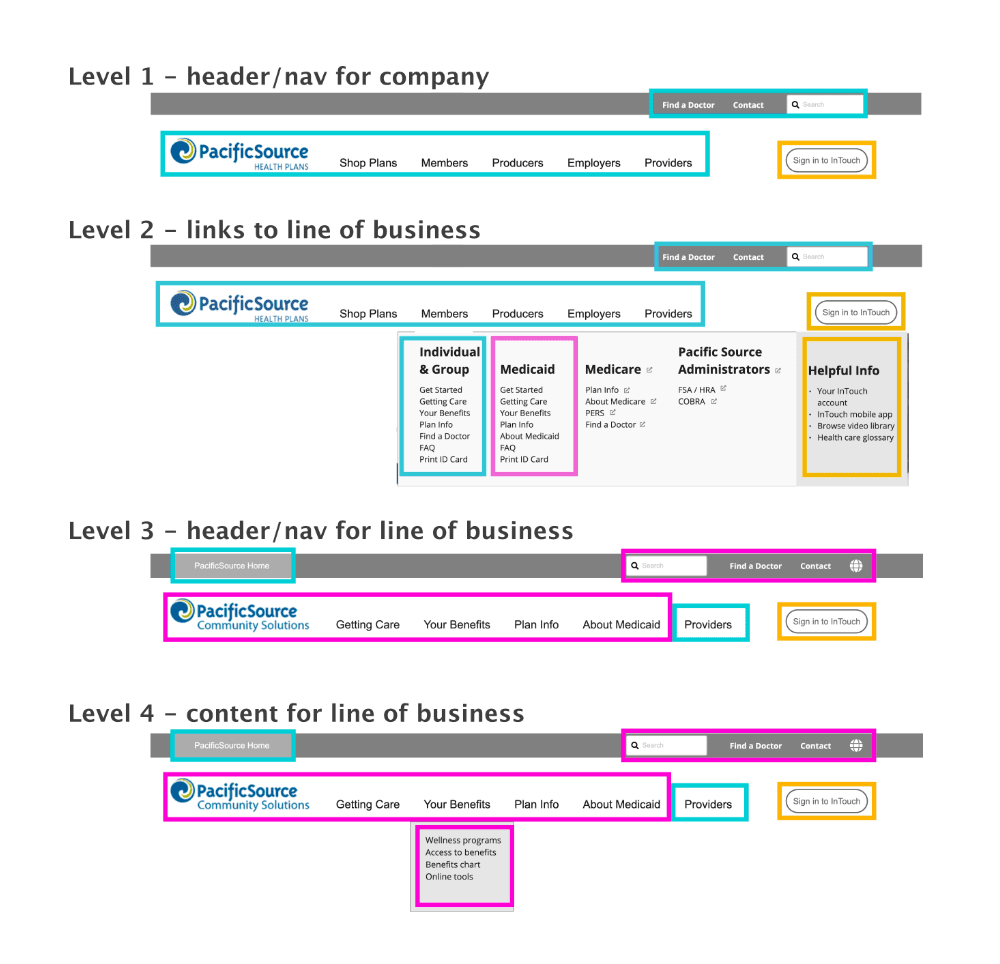
Color-coded navigational hierarchy to support parent, line of business, and global content.
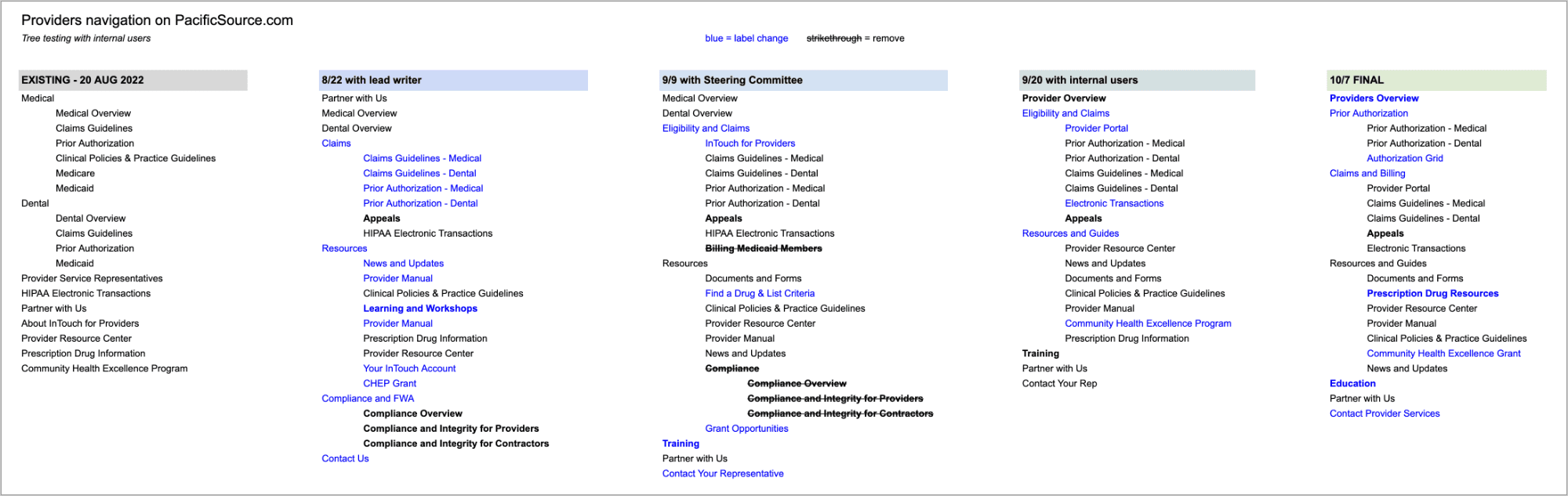
The provider section required an updated menu for the content consolidation and it went through multiple rounds of tree tests.
Content Strategy
Organize around what members want to do
"Members-first" is a core PacificSource value, carried out daily through customer service but not reflected in the Medicaid website. Digital content followed the operational structure and business terminology, with no connection to how a member actually seeks help. I led the shift by collaborating hands-on with writers, designers, and content owners across ~45 page and component builds, shaping the content while balancing member needs with business, compliance, and brand requirements.
Get a Ride
Focus on member tasks, not industry-speak
CHALLENGE
Non-Emergency Medical Transportation was an underused benefit buried in the provider directory, framed in clinical language, and missing key instructions.
SOLUTION
Reframe it as Get a Ride, place it within getting care, and organize the page around what members needed to know, schedule, and bring. The Creative Director later carried the treatment into member print collateral.


Member Handbook
Make a critical resource easier to find
Challenge
The Member Handbook is the most referenced resource for a health plan, but it was buried in tabbed content across five geographic pages and absent from primary navigation.
Solution
Create a single destination with clear regional options, links to supporting web content, and alternate language and accessible formats.


Document Search
Convert a static list into a searchable system
CHALLENGE
Providers faced more than 100 links on a static page with no search or filters. Files were disconnected from digital asset management, leaving broken links and outdated versions that created compliance risk.
SOLUTION
Avoided a custom build by using native Drupal capabilities. I sketched the behavior and had interactive working sessions with engineering to validate feasibility. We implemented a shared tagging structure for a filterable document search that could apply to other content types.


Delivery & LEadership
The internal experience needed designing, too
The strategy had to move through Creative, Marketing, Engineering, Compliance, Legal, executives, and more than 40 content owners and SMEs. As the first and only Digital PM, I held both the experience strategy and project delivery — turning decisions into scoped work, sequencing 45 sub-projects, surfacing risks and dependencies, and driving review and approval.
Governance
Involve the right stakeholders at the right time
Facilitated a 15-person governance committee and coordinated 40+ content owners and SMEs. Clarified decision roles between Creative and Web so recurring disagreements no longer required VP escalation.
Compliance
Build in regulatory needs
Integrated reading-level requirements, Spanish-language localization, WCAG AA accessibility, DEI review, and Legal review into the workflow. This reduced late-stage surprises, supporting an on-time launch, and passing the state compliance review.
Workflow & Execution
Create clarity in a complex workflow
Guided a nine-person core team of designers, writers, data analyst, and engineers while aligning work with policy changes, technical constraints, and executive expectations.
Mapped the end-to-end workflow across Adobe Workfront and Azure DevOps, defining requirements, handoffs, ownership, dependencies, and approval paths. Turned it into a shared playbook that outlasted the Medicaid launch.

New digital workflows clarified RACI needs and consistent cross-functional approvals in the regulated organization.
Impact & Proof
Members-first experience for Medicaid
The site launched on schedule, passed compliance review, and earned internal DEI recognition. Within three months of launch, site data showed stronger engagement across the experience.
Homepage Sessions
Total Sessions
Document Discoverability
Compliance
designed to scale
What began as a platform migration became a clearer member experience—and a more scalable way for PacificSource to build, govern, and evolve its digital products.
Marketing assumed ownership of the experience, supported by shared workflows and Workfront templates for future web work.
The line-of-business architecture became the foundation for the future Medicare site redesign.
Next Project

© 2026 Deb Mindel. All rights reserved.

Healthcare Website Rebuild
Medicaid
members-first redesign
As PacificSource's first Digital Project Manager, I led the year-long rebuild of a legacy Medicaid website for 350,000 members — shaping the UX, information architecture, and content strategy while managing the scope, workflow, and governance. The result was a user-driven experience in Drupal that could scale across lines of business.
Digital Program Leadership
UX & Content Strategy
Governance & Delivery
Client
PacificSource Health Plans
Role
Digital Project Manager UX & Content Strategist
Scale
350,000 Members Year-long Initiative
Core Team
3 Designers • 2 Developers • 2 Writers • Data analyst
Homepage Sessions
Total Sessions
Document Discoverability
Compliance
The Challenge
A migration wasn't going to fix this
PacificSource planned to move its Medicaid website from legacy .NET to Drupal and transfer ownership from IT to Marketing. But the site's structural and technical issues required attention:
Member navigation was essentially three links.
Missing and expired content created compliance risk.
Content reflected internal operations and terminology.
Key resources were buried.
Reliable analytics data were scarce.
The Drupal setup couldn’t support additional lines of business.
The organization behind the experience was equally complex: Creative, Marketing, Engineering, Compliance, Legal, Customer Service, executives, and more than 40 content owners and subject-matter experts all had a stake.
I owned the project and UX strategy end to end—turning research into a new information architecture and content direction, then translating that strategy into requirements, prioritized scope, and a delivery plan for a nine-person core team.
In 2023, the redesign replaced a generic, fragmented homepage with clear paths for members to get started, find care, understand benefits, access their account, and get help.
Discovery & Research
Understand the system before redesigning it
In order to set the direction, I needed to understand page-level usability issues and the systemic problems behind them. I dove into hands-on research while guiding the data analyst and lead writer, combining site and member evidence with internal requirements and comparative research to understand where the experience failed. And what the new system had to support.
CONTENT & IA AUDIT
Map the current experience
Inventoried the legacy site, mapped its structure, and identified outdated content, duplication, gaps, and maintenance risks.
Behavioral Data
See what users actually do
Analyzed site analytics, Hotjar behavior, and search patterns to see how members entered the site, where they struggled, and what they tried to find.
Customer Signals
Identify recurring needs
Synthesized survey feedback and recurring Customer Service questions to identify frequent requests and friction.
PEOPLE & REQUIREMENTS
Balance usability with constraints
Interviewed internal users and SMEs, reviewed comparable health plans, and translated business, accessibility, and regulatory needs into the design and build strategy.
The evidence pointed to a larger problem: the experience reflected how PacificSource operated, not how members looked for care and information.
Information Architecture
Design a structure that can scale
The research showed that the site needed to reflect how people entered, what they needed to do, and which audience they belonged to. Drupal also needed to support more than one product line. I designed a navigation and tagging framework for Medicaid that could accommodate future lines of business while preserving the existing PacificSource site.
AUDIENCE SEGMENTATION
Two core audiences, two content strategies
Members and providers needed different routes to information. Medicaid members engaged directly with Medicaid content, rarely using PacificSource's main site. Meanwhile, providers, who served patients across lines of business, had to check three separate line-of-business sites for similar information. I set the strategy for Medicaid to focus on members, and to consolidate provider content on the main PacificSource site.
Medicaid line-of-business subsite (highlighted) and the provider content that lives on the main PacificSource site.
Navigation Hierarchy
Create a framework that can expand
I worked with engineering to define how Drupal would support multiple lines of business, then designed a tagging system and flexible navigation model. It was built for Medicaid, extensible for future LoB, and could retrofit the existing PacificSource site.
Color-coded navigational hierarchy to support parent, line of business, and global content.
The provider section required an updated menu for the content consolidation and it went through multiple rounds of tree tests.
Content Strategy
Organize around what members want to do
"Members-first" is a core PacificSource value, carried out daily through customer service but not reflected in the Medicaid website. Digital content followed the operational structure and business terminology, with no connection to how a member actually seeks help. I led the shift by collaborating hands-on with writers, designers, and content owners across ~45 page and component builds, shaping the content while balancing member needs with business, compliance, and brand requirements.
Get a Ride
Focus on member tasks, not industry-speak
CHALLENGE
Non-Emergency Medical Transportation was an underused benefit buried in the provider directory, framed in clinical language, and missing key instructions.
SOLUTION
Reframe it as Get a Ride, place it within getting care, and organize the page around what members needed to know, schedule, and bring. The Creative Director later carried the treatment into member print collateral.
Member Handbook
Make a critical resource easier to find
Challenge
The Member Handbook is the most referenced resource for a health plan, but it was buried in tabbed content across five geographic pages and absent from primary navigation.
Solution
Create a single destination with clear regional options, links to supporting web content, and alternate language and accessible formats.
Document Search
Convert a static list into a searchable system
CHALLENGE
Providers faced more than 100 links on a static page with no search or filters. Files were disconnected from digital asset management, leaving broken links and outdated versions that created compliance risk.
SOLUTION
Avoided a custom build by using native Drupal capabilities. I sketched the behavior and had interactive working sessions with engineering to validate feasibility. We implemented a shared tagging structure for a filterable document search that could apply to other content types.
Delivery & LEadership
The internal experience needed designing, too
The strategy had to move through Creative, Marketing, Engineering, Compliance, Legal, executives, and more than 40 content owners and SMEs. As the first and only Digital PM, I held both the experience strategy and project delivery — turning decisions into scoped work, sequencing 45 sub-projects, surfacing risks and dependencies, and driving review and approval.
Governance
Involve the right stakeholders at the right time
Facilitated a 15-person governance committee and coordinated 40+ content owners and SMEs. Clarified decision roles between Creative and Web so recurring disagreements no longer required VP escalation.
Compliance
Build in regulatory needs
Integrated reading-level requirements, Spanish-language localization, WCAG AA accessibility, DEI review, and Legal review into the workflow. This reduced late-stage surprises, supporting an on-time launch, and passing the state compliance review.
Workflow & Execution
Create clarity in a complex workflow
Guided a nine-person core team of designers, writers, data analyst, and engineers while aligning work with policy changes, technical constraints, and executive expectations.
Mapped the end-to-end workflow across Adobe Workfront and Azure DevOps, defining requirements, handoffs, ownership, dependencies, and approval paths. Turned it into a shared playbook that outlasted the Medicaid launch.
New digital workflows clarified RACI needs and consistent cross-functional approvals in the regulated organization.
Healthcare Website Rebuild
Members-first experience for Medicaid
The site launched on schedule, passed compliance review, and earned internal DEI recognition. Within three months of launch, site data showed stronger engagement across the experience.
Homepage Sessions
Total Sessions
Document Discoverability
Compliance
designed to scale
What began as a platform migration became a clearer member experience—and a more scalable way for PacificSource to build, govern, and evolve its digital products.
Marketing assumed ownership of the experience, supported by shared workflows and Workfront templates for future web work.
The line-of-business architecture became the foundation for the future Medicare site redesign.
Next Project
© 2026 Deb Mindel. All rights reserved.

Healthcare Website Redesign
Medicaid
members-first redesign
As PacificSource's first Digital Project Manager, I led the year-long rebuild of a legacy Medicaid website for 350,000 members — shaping the UX, information architecture, and content strategy while managing the scope, workflow, and governance. The result was a user-driven experience in Drupal that could scale across lines of business.
Digital Program Leadership
UX & Content Strategy
Governance & Delivery
Client
PacificSource Health Plans
Role
Digital Project Manager UX & Content Strategist
Scale
350,000 Members Year-long Initiative
Core Team
3 Designers • 2 Developers • 2 Writers • Data analyst
Homepage Sessions
Total Sessions
Document Discoverability
Compliance
The Challenge
A migration wasn't going to fix this
PacificSource planned to move its Medicaid website from legacy .NET to Drupal and transfer ownership from IT to Marketing. But the site's structural and technical issues required attention:
Member navigation was essentially three links.
Missing and expired content created compliance risk.
Content reflected internal operations and terminology.
Key resources were buried.
Reliable analytics data were scarce.
The Drupal setup couldn’t support additional lines of business.
The organization behind the experience was equally complex: Creative, Marketing, Engineering, Compliance, Legal, Customer Service, executives, and more than 40 content owners and subject-matter experts all had a stake.
I owned the project and UX strategy end to end—turning research into a new information architecture and content direction, then translating that strategy into requirements, prioritized scope, and a delivery plan for a nine-person core team.
In 2023, the redesign replaced a generic, fragmented homepage with clear paths for members to get started, find care, understand benefits, access their account, and get help.
Discovery & Research
Understand the system before redesigning it
In order to set the direction, I needed to understand page-level usability issues and the systemic problems behind them. I dove into hands-on research while guiding the data analyst and lead writer, combining site and member evidence with internal requirements and comparative research to understand where the experience failed. And what the new system had to support.
CONTENT & IA AUDIT
Map the current experience
Inventoried the legacy site, mapped its structure, and identified outdated content, duplication, gaps, and maintenance risks.
Behavioral Data
See what users actually do
Analyzed site analytics, Hotjar behavior, and search patterns to see how members entered the site, where they struggled, and what they tried to find.
Customer Signals
Identify recurring needs
Synthesized survey feedback and recurring Customer Service questions to identify frequent requests and friction.
PEOPLE & REQUIREMENTS
Balance usability with constraints
Interviewed internal users and SMEs, reviewed comparable health plans, and translated business, accessibility, and regulatory needs into the design and build strategy.
The evidence pointed to a larger problem: the experience reflected how PacificSource operated, not how members looked for care and information.
Information Architecture
Design a structure that can scale
The research showed that the site needed to reflect how people entered, what they needed to do, and which audience they belonged to. Drupal also needed to support more than one product line. I designed a navigation and tagging framework for Medicaid that could accommodate future lines of business while preserving the existing PacificSource site.
AUDIENCE SEGMENTATION
Two core audiences, two content strategies
Members and providers needed different routes to information. Medicaid members engaged directly with Medicaid content, rarely using PacificSource's main site. Meanwhile, providers, who served patients across lines of business, had to check three separate line-of-business sites for similar information. I set the strategy for Medicaid to focus on members, and to consolidate provider content on the main PacificSource site.
Medicaid line-of-business subsite (highlighted) and the provider content that lives on the main PacificSource site.
Navigation Hierarchy
Create a framework that can expand
I worked with engineering to define how Drupal would support multiple lines of business, then designed a tagging system and flexible navigation model. It was built for Medicaid, extensible for future LoB, and could retrofit the existing PacificSource site.
Color-coded navigational hierarchy to support parent, line of business, and global content.
The provider section required an updated menu for the content consolidation and it went through multiple rounds of tree tests.
Content Strategy
Organize around what members want to do
"Members-first" is a core PacificSource value, carried out daily through customer service but not reflected in the Medicaid website. Digital content followed the operational structure and business terminology, with no connection to how a member actually seeks help. I led the shift by collaborating hands-on with writers, designers, and content owners across ~45 page and component builds, shaping the content while balancing member needs with business, compliance, and brand requirements.
Get a Ride
Focus on member tasks, not industry-speak
CHALLENGE
Non-Emergency Medical Transportation was an underused benefit buried in the provider directory, framed in clinical language, and missing key instructions.
SOLUTION
Reframe it as Get a Ride, place it within getting care, and organize the page around what members needed to know, schedule, and bring. The Creative Director later carried the treatment into member print collateral.
Member Handbook
Make a critical resource easier to find
Challenge
The Member Handbook is the most referenced resource for a health plan, but it was buried in tabbed content across five geographic pages and absent from primary navigation.
Solution
Create a single destination with clear regional options, links to supporting web content, and alternate language and accessible formats.
Document Search
Convert a static list into a searchable system
CHALLENGE
Providers faced more than 100 links on a static page with no search or filters. Files were disconnected from digital asset management, leaving broken links and outdated versions that created compliance risk.
SOLUTION
Avoided a custom build by using native Drupal capabilities. I sketched the behavior and had interactive working sessions with engineering to validate feasibility. We implemented a shared tagging structure for a filterable document search that could apply to other content types.
Delivery & LEadership
The internal experience needed designing, too
The strategy had to move through Creative, Marketing, Engineering, Compliance, Legal, executives, and more than 40 content owners and SMEs. As the first and only Digital PM, I held both the experience strategy and project delivery — turning decisions into scoped work, sequencing 45 sub-projects, surfacing risks and dependencies, and driving review and approval.
Governance
Involve the right stakeholders at the right time
Facilitated a 15-person governance committee and coordinated 40+ content owners and SMEs. Clarified decision roles between Creative and Web so recurring disagreements no longer required VP escalation.
Compliance
Build in regulatory needs
Integrated reading-level requirements, Spanish-language localization, WCAG AA accessibility, DEI review, and Legal review into the workflow. This reduced late-stage surprises, supporting an on-time launch, and passing the state compliance review.
Workflow & Execution
Create clarity in a complex workflow
Guided a nine-person core team of designers, writers, data analyst, and engineers while aligning work with policy changes, technical constraints, and executive expectations.
Mapped the end-to-end workflow across Adobe Workfront and Azure DevOps, defining requirements, handoffs, ownership, dependencies, and approval paths. Turned it into a shared playbook that outlasted the Medicaid launch.
New digital workflows clarified RACI needs and consistent cross-functional approvals in the regulated organization.
Impact & Proof
Members-first experience for Medicaid
The site launched on schedule, passed compliance review, and earned internal DEI recognition. Within three months of launch, site data showed stronger engagement across the experience.
Homepage Sessions
Total Sessions
Document Discoverability
Compliance
designed to scale
What began as a platform migration became a clearer member experience—and a more scalable way for PacificSource to build, govern, and evolve its digital products.
Marketing assumed ownership of the experience, supported by shared workflows and Workfront templates for future web work.
The line-of-business architecture became the foundation for the future Medicare site redesign.
Next Project
© 2026 Deb Mindel. All rights reserved.